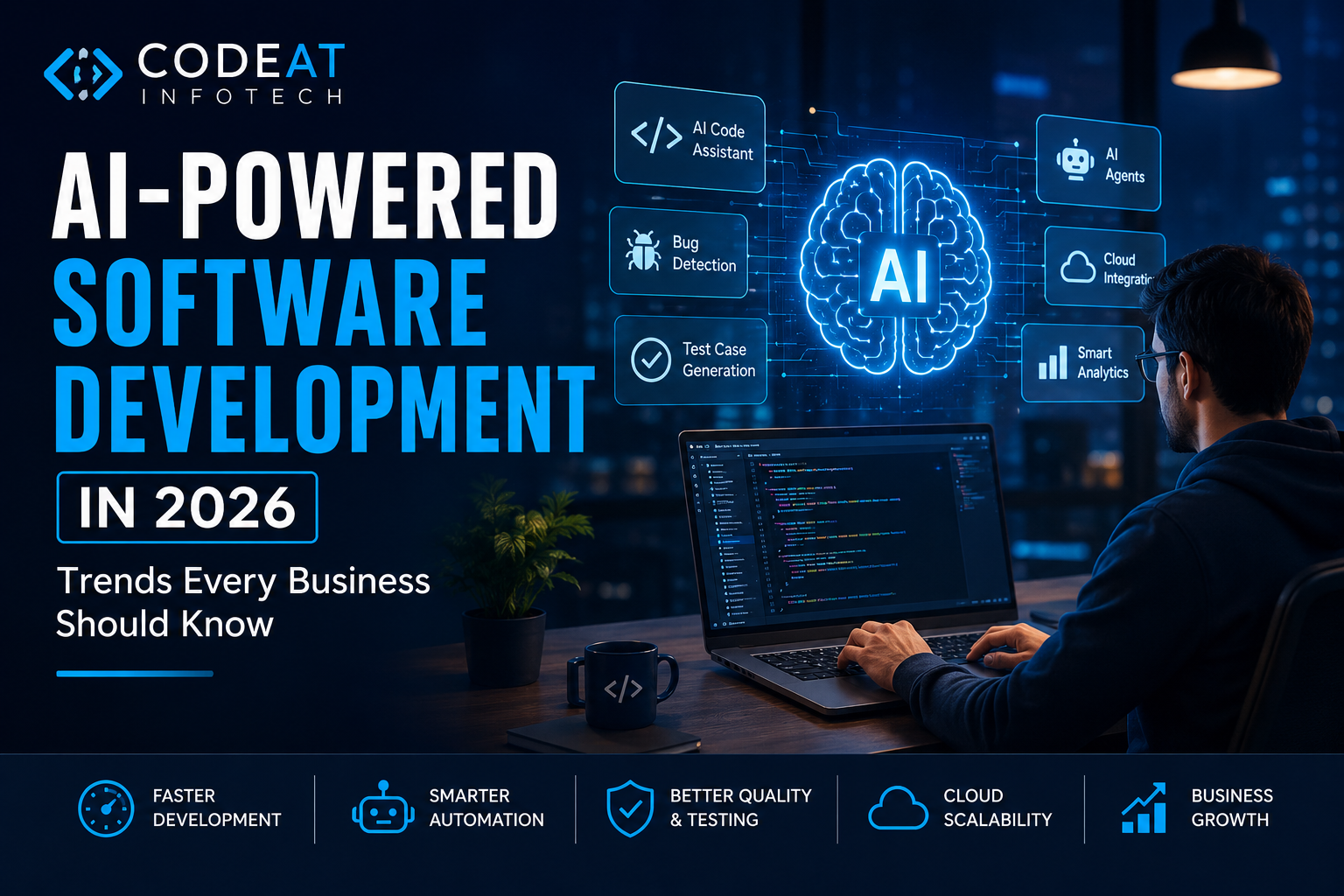
AI Is Changing the Way Software Is Built
Software development is entering a new phase in 2026. Artificial Intelligence is no longer limited to chatbots or content generation. AI is increasingly becoming part of the software development lifecycle, helping teams write code, identify bugs, generate tests, analyze data, automate workflows, and build smarter applications.
For businesses, this shift creates an opportunity to develop software faster while improving productivity and customer experiences. However, successful AI adoption requires more than simply adding an AI feature to an existing application.
1. AI-Powered Software Development
AI coding assistants and development tools are helping developers throughout the development process. From generating code and explaining existing code to finding potential bugs and creating test cases, AI can reduce repetitive development work.
This does not mean developers are becoming unnecessary. Instead, developers are increasingly focusing on architecture, business logic, security, testing, and validating AI-generated output.
2. AI Agents Are Moving Beyond Chatbots
One of the biggest developments in 2026 is the growth of AI agents. Unlike traditional chatbots that mainly respond to questions, AI agents can be designed to understand goals, plan multiple steps, interact with software systems, and complete specific workflows under appropriate human oversight.
Businesses can use AI agents for tasks such as customer support, lead qualification, document processing, reporting, internal knowledge search, and workflow automation.
3. Automated Testing Is Becoming More Important
As AI makes software development faster, testing and validation become increasingly important. AI-generated code still needs to be reviewed, tested, secured, and validated before it is used in production.
Modern development teams are therefore combining AI-assisted development with automated testing, code review, monitoring, and quality assurance.
4. AI and Cloud Technology Are Working Together
Modern AI applications require scalable infrastructure. Cloud platforms make it easier for businesses to deploy applications, process data, scale resources, and integrate AI services without building every component from scratch.
Cloud-native architecture, APIs, serverless technologies, databases, and AI services are becoming important building blocks for modern digital products.
5. AI Is Creating Smarter Business Applications
Businesses are moving from traditional software toward intelligent applications that can analyze information and assist users with decisions.
Examples include:
- AI-powered customer support systems
- Intelligent education platforms
- Automated business reporting
- AI-powered document processing
- Personalized e-commerce experiences
- Predictive analytics dashboards
- Workflow automation systems
What Businesses Should Focus on in 2026
AI adoption should be driven by real business problems rather than technology hype. Companies should first identify repetitive or time-consuming processes where automation can provide measurable value.
Security, privacy, data quality, human oversight, testing, and scalability should also be considered before deploying AI-powered systems.
Conclusion
AI is becoming an important part of modern software development. In 2026, businesses that combine AI with strong software architecture, reliable development practices, security, and human expertise can create faster and smarter digital solutions.
The future of software development is not simply about replacing developers with AI. It is about enabling developers and businesses to build better products, automate repetitive work, and focus more on innovation and business value.
Looking to build a modern website, business application, ERP, mobile app, or AI-powered solution? The right technology strategy can help turn your business requirements into a scalable digital product.